A representative mid-market SaaS company stopped spending on cybersecurity reactively and started operating it as a program — with a single C4I command center over five editions, and the owner finally able to decide.
An illustrative composite built on AQUILA C4I's reference deployment model and the platform's published outcome ranges. It represents the modeled mid-market range — not a single named customer. Real named results will be published as customers agree to be referenced.
Like most organizations, the company had bought its way toward security one point tool at a time. Across the industry, the typical enterprise now runs 83 security solutions from 29 vendors (IBM Institute for Business Value with Palo Alto Networks, Jan 2025). The result here was familiar: alerts no one could prioritize, audit prep that consumed entire quarters, and a CEO who could approve the budget but never answer a simple board question — are we actually protected?
AQUILA C4I didn't add a tool. It put a command center on top of the program and ran the CRAM™ method — the same discipline the most mature 3% of programs use — so the company could converge what it already had and decide what mattered.
Signals from the existing stack pulled into one C4I view across all five editions.
Overlapping point tools identified and consolidated; redundant spend cut.
BEN, the AI advisor, surfaces the decisions on the owner's desk — the owner decides; the program responds.
Posture, response times, and audit readiness tracked continuously — proof the business can read.
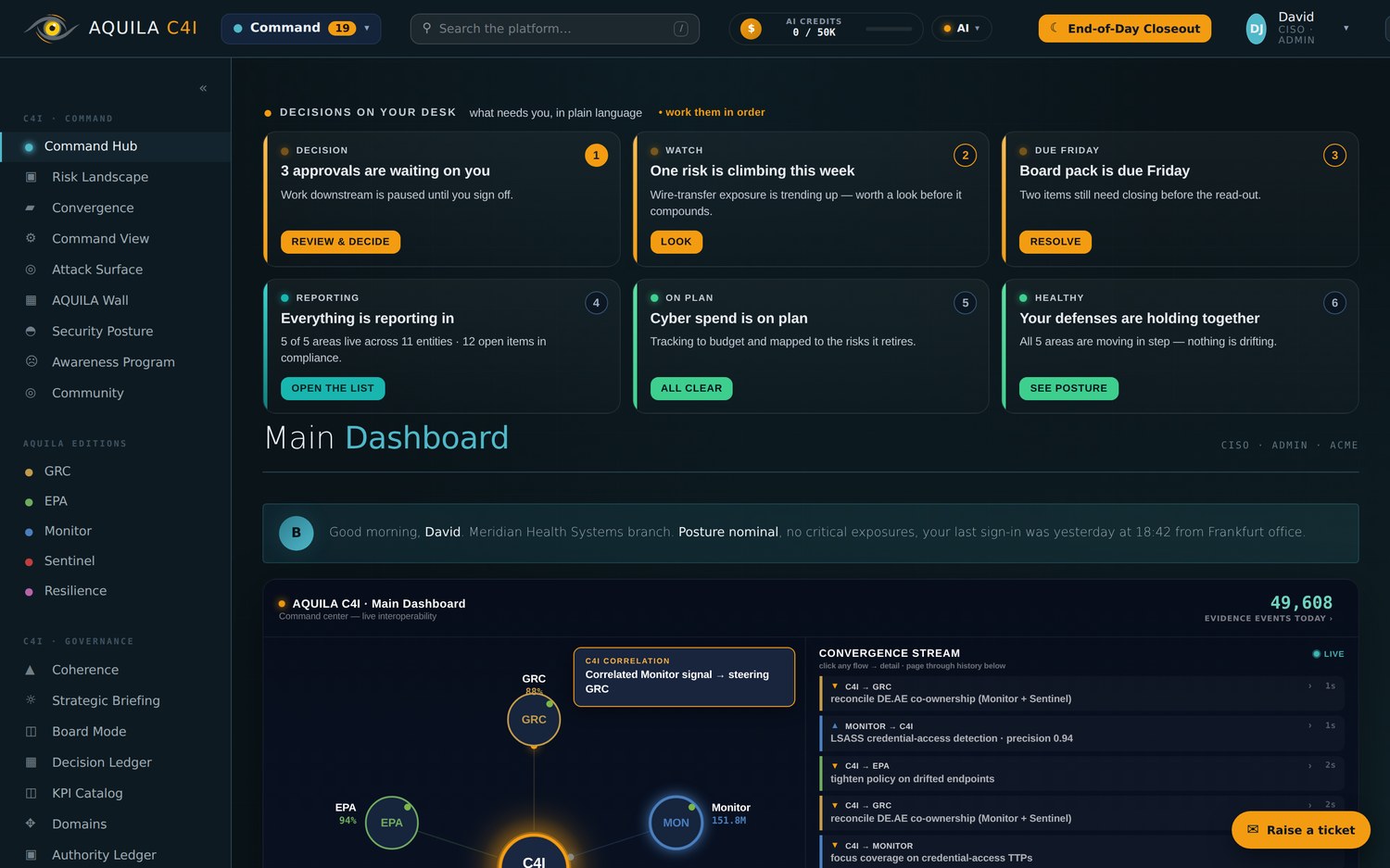
Figures are AQUILA C4I's published outcome ranges for a mid-market deployment, applied to this composite profile. They represent a modeled range, not a single audited customer result.
AQUILA C4I is what I owe the leaders coming after me: a way to do this job without the heroics.Chen HefferFounder & CEO, CyTech International · inventor of CRAM™ · author of the CISO training series
See the command center over your five editions — and the decisions it would put on your desk.
Book a demo